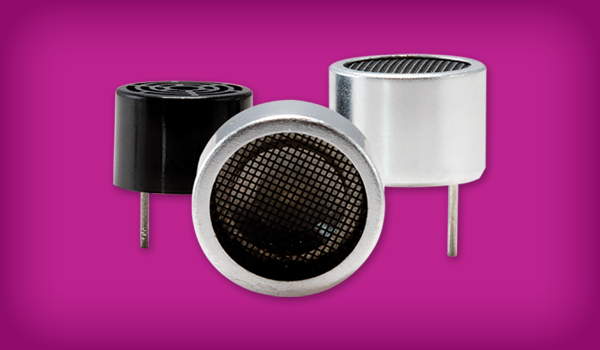
Ultrasonic Sensor Beam Angles: How Beam Patterns Affect Detection
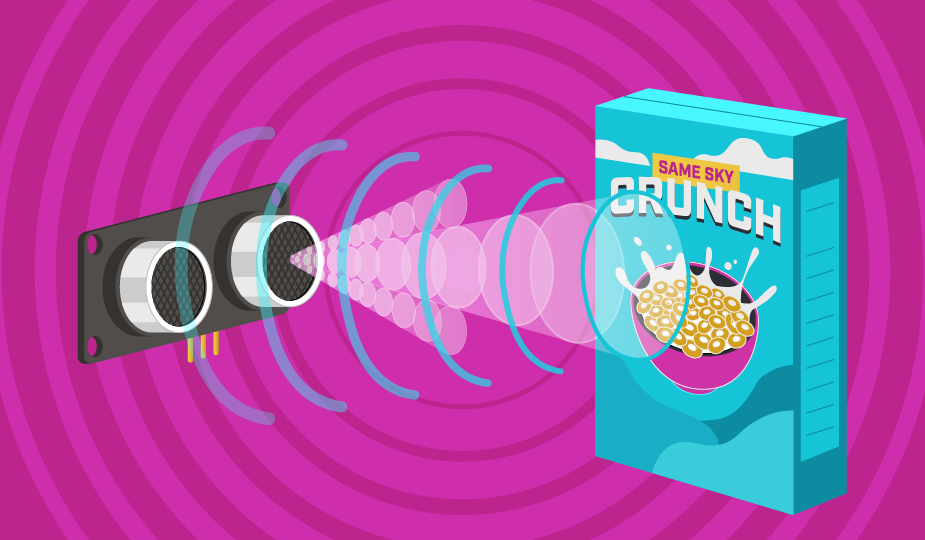
Ultrasonic sensors are common and valuable tools in modern engineering applications, trusted for reliably delivering distance measurements and object detection across a wide range of environments. However, the success of any ultrasonic sensing application often depends on a single, frequently misunderstood specification: beam angle. By defining how acoustic energy propagates through the air, the beam angle dictates not just the sensor’s effective range, but also its precision and susceptibility to environmental variables. In this article, we will examine how beam geometry interacts with target characteristics and operating frequency, providing the insights you need to select the right sensor and optimize its performance for your specific application.
If you’re new to ultrasonic sensing, check out our blog and video on the basics of ultrasonic sensors. They introduce ultrasonic operating principles, sensor types, and key specifications for selecting a device. Or shop Same Sky’s ultrasonic sensors product line.
What Is an Ultrasonic Sensor Beam Angle?
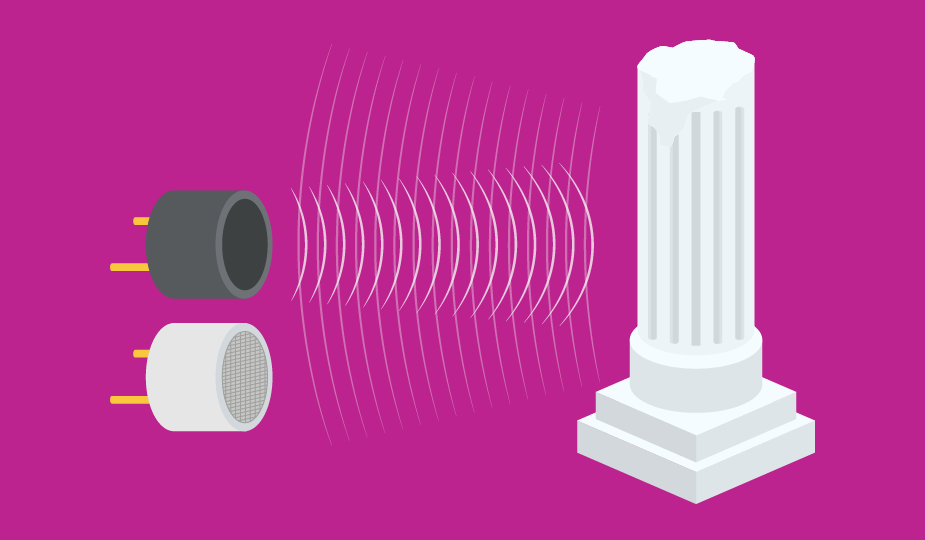
An ultrasonic sensor beam angle describes how widely ultrasonic energy spreads after leaving the transducer. Although beam patterns are often illustrated as simple cones, the actual acoustic field consists of a strong central main lobe surrounded by smaller side lobes. Beam angle is typically specified at the -6 dB point, where the amplitude has fallen to about half of its peak value. This specification helps engineers estimate the effective sensing area, but real-world performance also depends on the target’s size, shape, orientation, and material. Because ultrasonic energy spreads rather than remaining perfectly focused, beam angle directly influences detection range, measurement accuracy, and the likelihood of unwanted reflections.
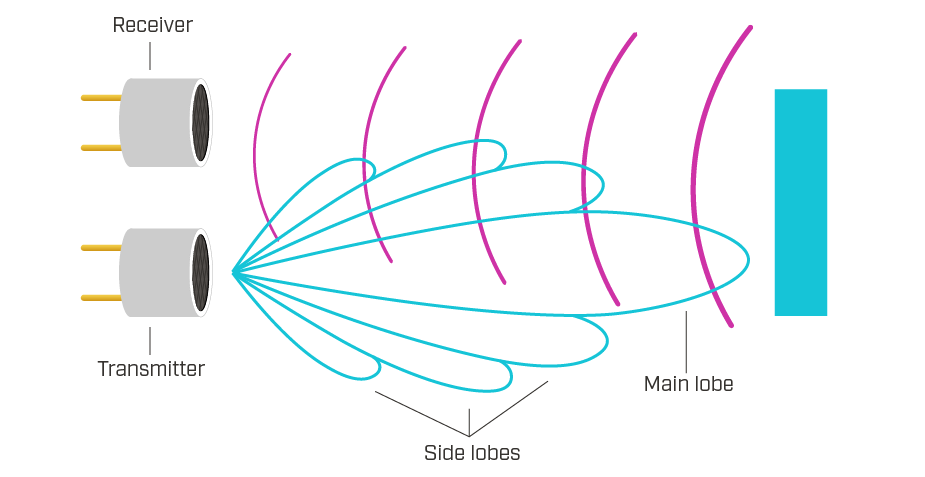
Real ultrasonic beams consist of a dominant main lobe surrounded by smaller side lobes rather than a single, perfectly uniform cone
Narrow vs. Wide Beam Angles: What Are the Tradeoffs?
Beam angle determines how concentrated the transmitted acoustic energy remains as it travels through the air. There are tradeoffs between narrow and wide beams.
| Narrow Beam | Wide Beam |
|---|---|
| Longer detection range | Greater coverage area |
| Better target discrimination | Easier to detect objects across a wider field |
| Reduced off-axis reflections | More susceptible to unintended reflections |
| Better for small or distant objects | Better for presence detection |
Applications requiring precise distance measurements or detection of small objects generally benefit from narrower beam angles. Conversely, occupancy sensing or general object detection often benefits from wider beams that monitor a larger area.
How Do Target Characteristics Affect Ultrasonic Detection?
A common, though erroneous, thought is that any object inside the beam will always be detected. In reality, several factors determine whether enough reflected energy returns to the receiver.
Target Material
Hard, flat materials such as metal, glass, or rigid surfaces typically produce strong echoes because they reflect most of the incident ultrasonic energy. However, soft materials, such as foam, fabric, insulation, or porous packaging, absorb significantly more acoustic energy, reducing the strength of the returning signal and shortening effective detection range.
Surface Angle
Object orientation can be just as important as material. A surface positioned perpendicular to the sensor reflects energy directly back to the receiver. As the surface tilts, much of the energy reflects away instead of returning to the sensor. This is known as specular reflection and explains why angled panels, curved tanks, pipes, and sloped containers may not be detected even when they fall well within the specified sensing range.
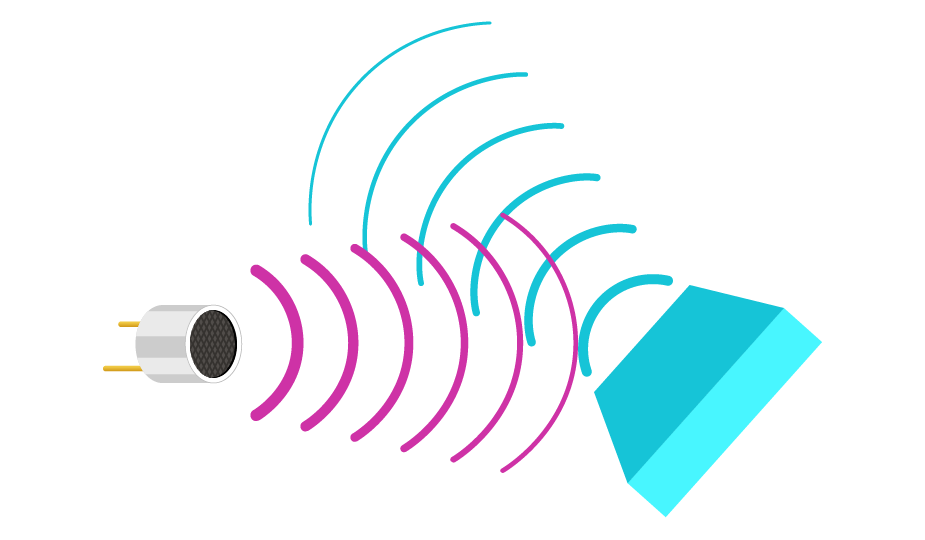
As the ultrasonic pulse hits the angled surface, it is reflected in a different direction with only a minimal amount of energy returning back to the receiver
Object Size
As distance increases, the ultrasonic beam expands. Small objects intercept only a small portion of the transmitted energy, leaving less sound available to reflect back toward the receiver. For this reason, thin rods, wires, and narrow pipes are generally more difficult to detect than large, flat surfaces at the same distance.
How Does Operating Frequency Affect Beam Width and Range?
Operating frequency influences both beam geometry and atmospheric attenuation. Higher-frequency ultrasonic sensors typically produce narrower beams, improving resolution, and the ability to distinguish nearby objects. However, higher frequencies are absorbed more readily by air, limiting maximum sensing distance.
Lower-frequency sensors propagate farther because they experience less atmospheric attenuation, but they generally produce wider beam patterns and lower resolution. Engineers often balance these competing characteristics when selecting a sensor for a particular application.
What Causes an Ultrasonic Sensor’s Blind Zone?
The blind zone of an ultrasonic sensor is the minimum distance at which a target can be measured reliably, but the cause of that limitation depends on the sensor configuration. In an ultrasonic transceiver, where the same transducer is used to transmit and receive, the transducer continues to ring after the transmit pulse ends for a short period, known as ringdown. During this brief interval, returning reflections cannot be distinguished from the transmitted pulse, making very close objects difficult or impossible to detect. This ringdown time therefore contributes directly to the transceiver’s minimum measurable distance.
However, when there is a separate transmitter and receiver, ringdown in the transmitter is less limiting because the receiver is physically independent. The minimum measuring distance is still affected by the duration of the transmitted ultrasonic pulse. If an echo returns while the transmitter is still emitting sound, the received signal is difficult to distinguish from the outgoing pulse. The physical spacing between the transmitter and receiver also matters. At very short distances, the transmit and receive beam patterns may not overlap sufficiently for a reflected signal to reach the receiver.
Blind zones vary by sensor design, operating frequency, and signal processing methods. Beam angle, element spacing, pulse duration, and signal-processing effectiveness can thus all influence the practical blind zone. Applications requiring short-range measurements should always verify the specified minimum detection distance.
Design Tips for Reliable Ultrasonic Detection
While no sensor is ideal for every application, several design practices improve measurement reliability.
- Select a beam angle appropriate for the target size and required coverage.
- Position the sensor so target surfaces are as perpendicular as possible.
- Account for blind zones during the mechanical design portion of the process.
- Consider target material and surface finish when estimating detection range.
- Match operating frequency to the required balance between range and resolution.
Evaluating these factors early in the design process helps reduce false detections and unexpected performance issues.
Frequently Asked Questions
What is the beam angle in an ultrasonic sensor?
Beam angle is the angular spread of emitted ultrasonic energy, typically measured at the -6 dB point. It defines the sensor’s effective sensing field.
Does a narrower beam always provide better performance?
Not necessarily. Narrow beams improve range and target discrimination, while wider beams provide greater area coverage. Like many things in engineering, the best choice depends on the application.
Why are angled surfaces difficult for ultrasonic sensors to detect?
Ultrasonic waves reflect much like light from a mirror. If a surface is tilted, the reflected sound may travel away from the sensor rather than return to the detector.
Why can’t ultrasonic sensors detect objects very close to the transducer?
Objects within an ultrasonic sensor’s blind zone may not reliably be detected, due to factors such as transducer ringdown, transmit pulse duration, and, in separated transmitter-receiver pairs, sensor spacing and beam geometry. The transducer continues vibrating briefly after transmitting a pulse. During this period, called the ringdown, returning echoes cannot be distinguished from the transmitted signal.
Does a higher operating frequency increase detection range?
Generally, no. Higher frequencies improve resolution and often produce narrower beam angles, but they also experience greater attenuation in air, reducing maximum sensing distance.
Summary
Beam angle is one of the most important characteristics affecting ultrasonic sensor performance because it influences how sound propagates, how objects reflect acoustic energy, and how reliably echoes return to the receiver. Understanding the relationships between beam angle, operating frequency, blind zones, target materials, and surface orientation allows engineers to select sensors that perform more consistently in real-world applications.
Key Takeaways
- Beam angle determines how ultrasonic energy spreads and directly affects detection range, accuracy, and target discrimination.
- Narrow beam angles provide longer range and better detection of small objects.
- Wide beam angles cover larger areas but are more susceptible to unwanted reflections.
- Target material, surface angle, object size, and operating frequency all influence detection reliability.
- Understanding beam behavior helps engineers select the appropriate ultrasonic sensor and reduce false detections.
 Tags:
Tags:
Additional Resources