Non-Latching vs. Latching Relays – What’s the Difference?
What’s the Difference Between Non-Latching and Latching Relays?
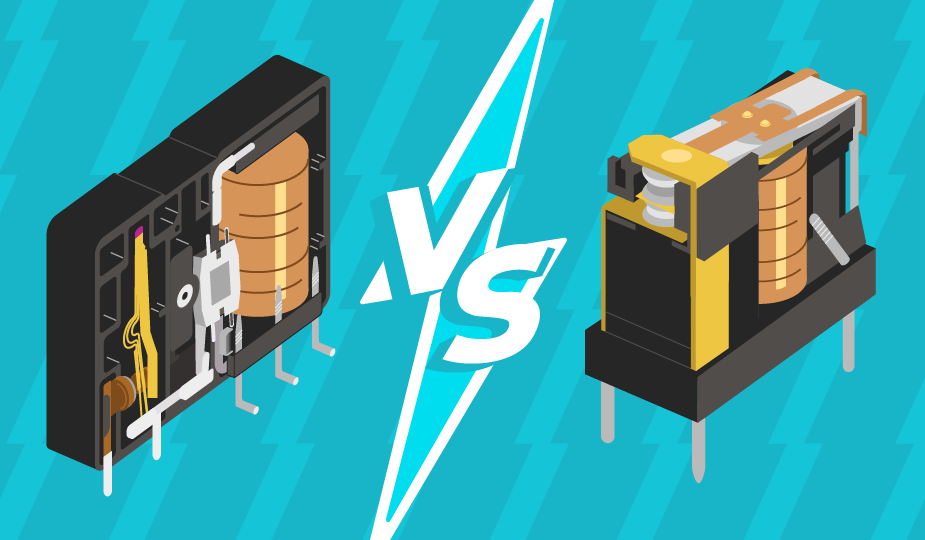
A non-latching relay only stays switched on while power is applied to the coil, whereas a latching relay maintains its state even after power is removed. Because these two relay types operate differently, they excel in different scenarios. As technology continues to evolve, understanding the difference between these relay types becomes ever more crucial for design engineers. As they are both important yet used in different scenarios, Same Sky offers both power relay types, and we want to delve into the fundamental differences, benefits, and drawbacks between the two types as well as best practices in implementation for each. Interested in more relays content? Check out our other blog topics:
- An Introduction to Power Relays
- An Introduction to Signal Relays
- The Importance of Power Relays in Reliable and Efficient HVAC Design
- Or watch our Relays Explained video
Fundamentals of Relays
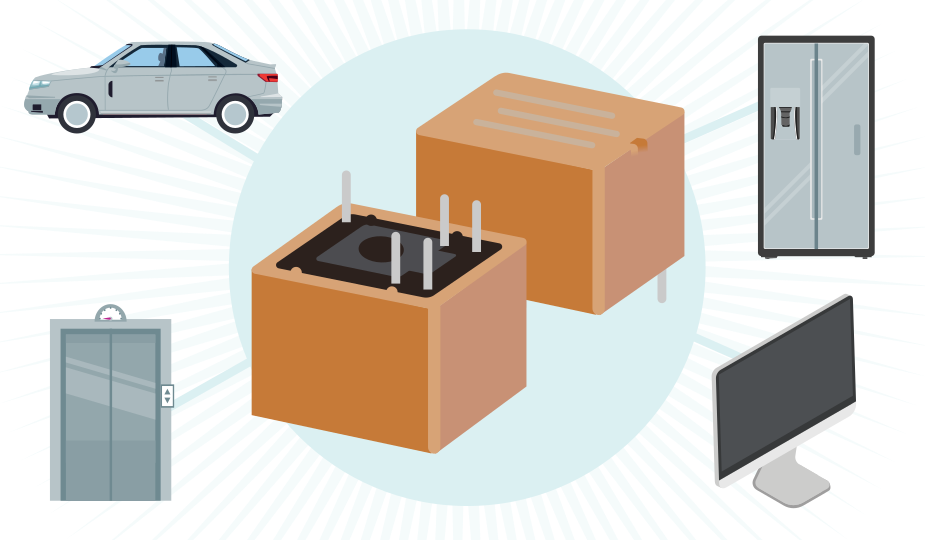
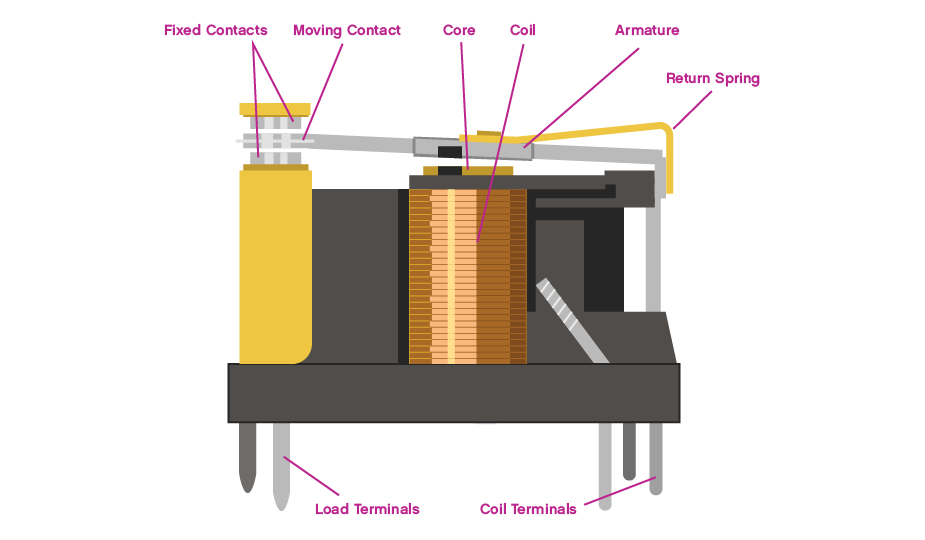
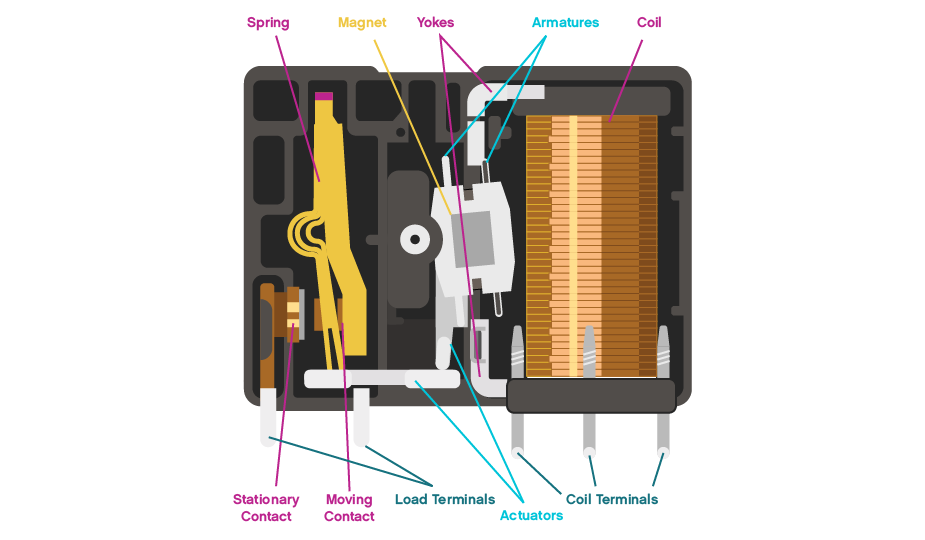
Before diving deeper into latching and non-latching relays, it’s important to understand the basics of relay construction. We discussed relays in more detail in our What You Need to Know About Relays blog but we will briefly review their core functionality here. An electromechanical relay consists of a coil that generates a magnetic field when energized, an armature that moves to open or close the contacts, and a return spring that reverts the armature to its default position in non-latching designs. The contacts can be configured in different arrangements, such as SPST (single-pole single-throw) or SPDT (single-pole double-throw).
As mechanical devices, switching is not instantaneous and electromechanical relays have important timing characteristics that impact performance. Key timing characteristics include the following:
- Operate time: how long it takes contacts to change state after the coil is energized.
- Release time: how long it takes for contacts to return to their default state after coil power is removed.
- Contact bounce: a series of brief, rapid open/close events during switching that often requires debounce circuitry.
- Minimum pulse width: the shortest drive pulse needed to switch or latch a relay reliably.
These parameters are even more important in high-speed systems or with latching relays.
What Are Non-Latching Relays?
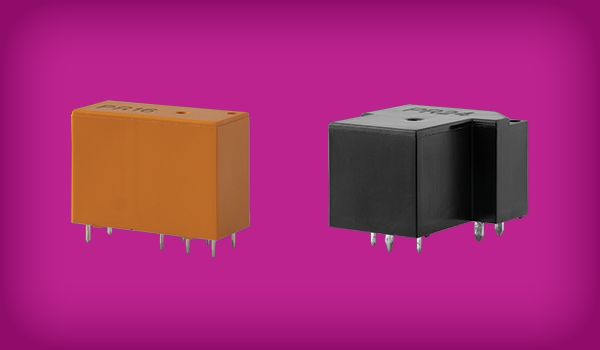
Non-latching relays, sometimes known as monostable relays, have a single stable state and require continuous current through the coil to remain actuated. When the coil is de-energized (i.e. when current stops flowing through the coil), the return spring forces the contacts back to their default, stable position. This makes non-latching relays ideal for safety-critical systems that need to revert to a fail-safe state on power loss. Another benefit of non-latching relays is that their drive circuitry is simple and inexpensive to implement. However, the need for continuous current during operation increases power consumption and prolonged activation of the relay can cause coil heating, which may reduce lifespan. To see a selection of the different types available, you can peruse Same Sky’s selection of non-latching power relays as well as signal relays.
What Are Latching Relays?
Latching relays are also known as bistable relays and are notable because they remain in their last switched position even when coil power is removed. They use either a permanent magnet or a mechanical latch to hold the armature in place and can be reset or switched with a short electrical pulse. Latching relays are beneficial because they require no hold current, significantly reducing or even removing standby power usage. As the coil is only used for very short periods of time, it is not subjected to as much heat, reducing heat degradation. Finally, as latching relays retain their last state even during a power loss, they can be very useful in systems where maintaining the operational state is important. However, there are always tradeoffs in design and engineering. Latching relays require more complex drive circuitry than their non-latching counterparts, requiring polarity-reversing circuitry for single-coil types. For versions that use permanent magnets, those magnets can be demagnetized by overcurrent or be disengaged with excessive mechanical shock, leading to their failure. To see actual options, you can look through Same Sky’s selection of latching power relays.
What's the Difference Between Single-Coil and Double-Coil Latching Relays?
Single-coil latching relays and double-coil latching relays both maintain their switched state even after coil power is removed, but they operate differently. With a single-coil latching relay, there is one coil used to both latch and unlatch the relay. A double-coil latching relay, on the other hand, uses two separate coils – one to latch the relay, another to unlatch it. Both types of latching relays hold their state without continuous power. However, while a single-coil relay requires reversing the coil polarity to reset, a double-coil relay uses a separate pair of pins for reset. While this uses more pins and a slightly larger footprint, the circuitry is simpler because it does not require polarity reversal.
Comparison of Non-Latching and Latching Relays
For a quick comparison, this table illustrates the differences between non-latching relays and latching relays.
| Feature | Non-Latching Relay | Latching Relay |
|---|---|---|
| Standby Coil Power | Higher | Zero |
| Power-loss Behavior | Returns to default position | Maintains last position |
| Drive Complexity | Simple | More complex |
| Size/Cost | Generally lower | Generally higher |
| Common Use-Cases | Safety-critical or simple control systems | Energy-efficient |
Best Practices for Implementing Latching or Non-Latching Relays
Even the highest-quality relays, when used in the right application, require adherence to best practices to ensure optimal performance and a long service life. Proper sizing, thoughtful placement, and integration into well-designed circuits can mean the difference between years of trouble-free operation or premature failure. While an experienced designer’s full toolkit of tips and techniques cannot be condensed into a single section of this article, there are several straightforward practices that deliver significant benefits.
For non-latching relay coils that use direct current, one of the most important steps is to use a flyback diode across the coil. This single, simple component suppresses voltage spikes generated when the coil is de-energized, protecting the driving electronics and surrounding circuitry from damage. Additionally, reducing inrush currents can further protect the relay, its contacts, and upstream power-path components, improving overall reliability. This is especially important when switching capacitive or magnetizing loads, which can draw large current surges at turn-on.
For latching relays, the biggest area of improvement is found in precisely controlling actuation. Using a dedicated driver IC or an H-bridge simplifies polarity reversal for single-coil designs and ensures consistent operation. Pulse width control is also critical. If the pulse is too short, the relay may fail to actuate. Too long, and energy is wasted while the coil overheats unnecessarily. In demanding applications, it is also prudent to consider vibration and shock protection, as mechanical disturbances can sometimes cause unintended switching in latching designs.
For either type of relay, there are also more general best practices. You should derate contact ratings to avoid pushing the relay to its maximum limits. You should also ensure adequate ventilation or thermal management to handle heat buildup while making sure to choose sealed options in dusty or humid environments. With these few measures, designers can dramatically improve the reliability and longevity of both non-latching and latching relays.
How to Choose Between Non-Latching and Latching Relays
Choosing the right relay begins with understanding the needs of your application. The coil voltage and current must align with your available power source, while the contact rating must be appropriate for the load type. As mentioned in the Best Practices section, in the sizing of the relays, there should be an appropriate derating to make sure the relay is not constantly running at maximum capacity. The relay’s maximum switching voltage also must match or exceed your system’s operating requirements, while the power budget should also be considered. Safety considerations and environmental conditions should influence your decision, selecting relays with the appropriate features to meet the requirements of the application.
While these are the general requirements for relay selection, there are a few specific questions that you can ask regarding non-latching and latching relays:
| Question | Recommendation |
|---|---|
| Does your application need to return to a default state with a power loss? | Non-latching relay |
| Does your application need to maintain its state even after a power loss? | Latching relay |
| Do you need minimal standby power in your application? | Latching relay |
| Does the drive circuitry need to be as simple as possible? | Non-latching relay |
Conclusion
Selecting between non-latching and latching relays requires balancing energy efficiency, design complexity, and application needs. Non-latching relays offer straightforward operation and fail-safe functionality, while latching relays deliver low-power performance and state retention. Same Sky offers both types, ensuring engineers and designers can find the right solution for their specific design challenges.
Key Takeaways
- Non-latching relays require constant coil power to stay energized and automatically return to a default position when power is removed.
- Latching relays stay in their last switched state without consuming current, reducing standby power and preserving the operating state even with power interruptions.
- Single-coil latching relays rely on polarity reversal to set or reset the relay, while double-coil latching relays use separate control pins to simplify drive circuitry.
 Tags:
Tags:
Additional Resources