How to Mount Waterproof Speakers for Reliable Ingress Protection
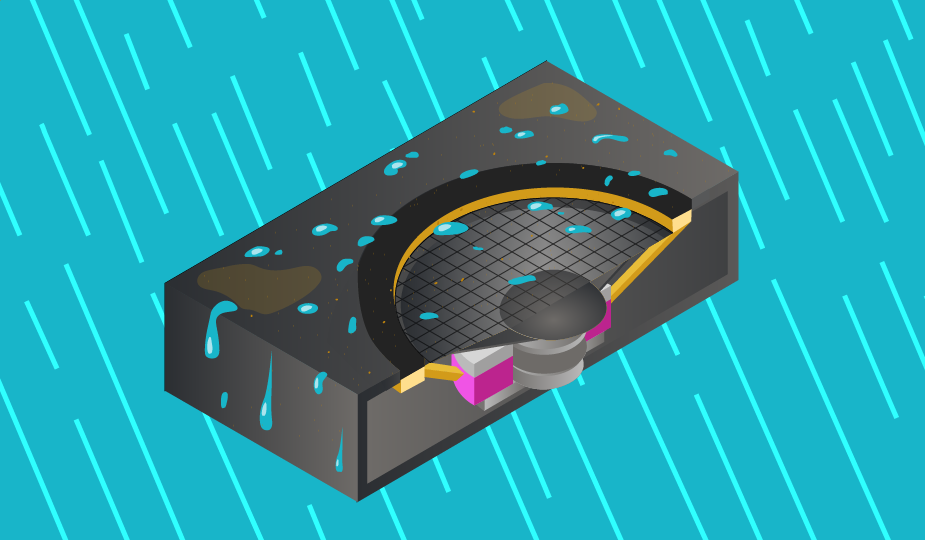
Designing with an IP-rated speaker does not automatically make your product IP rated. For engineers who are developing outdoor, portable, or washable products, waterproof speaker mounting must be treated as a full-system solution. The speaker, mounting method, seal design, grille geometry, enclosure surface quality, and expected environmental stresses all work together. In practice, reliable ingress protection depends on getting sealing, retention, and drainage to support one another over the life of the product, not just passing a component-level specification on paper. Shop Same Sky’s range of waterproof speakers.
What Do IP Ratings Actually Mean for Speaker Integration?
IP ratings are useful, but they are often misunderstood during product design. IP ratings, short for “ingress protection” ratings, are standardized classifications defined by IEC 60529 that describe how well an enclosure resists the entry of solid particles and liquids. The first digit refers to protection against solid objects such as dust, while the second digit refers to protection against water exposure under specific test conditions. For example, an IP65 device is dust-tight and protected against water jets, while an IP67 device is dust-tight and protected against temporary submersion. These ratings are useful because they provide a common shorthand for comparing environmental protection levels. But they only describe performance under controlled laboratory tests and specific conditions. They do not automatically account for real-world variables such as mounting orientation, aging seals, vibration, thermal cycling, or repeated exposure in the field. Below is a simple chart showing some of the most popular IP configurations:
| IP Rating | Solid Protection | Liquid Protection | Typical Meaning |
|---|---|---|---|
| IP54 | Limited dust ingress | Splashing water | Basic outdoor or light industrial protection |
| IP55 | Limited dust ingress | Water jets | Better protection for exposed environments |
| IP65 | Dust-tight | Water jets | Common for products needing strong splash and spray resistance |
| IP66 | Dust-tight | Powerful water jets | Suitable for harsher washdown or outdoor exposure |
| IP67 | Dust-tight | Submersion up to 1m for up to 30 minutes | Often used where brief submersion is possible |
| IP68 | Dust-tight | Manufacturer specified submersion over 1m for over 30 minutes | Used when longer or deeper immersion may occur |
Engineers and designers sometimes assume that if a speaker is rated IP67 or better, the application is covered. That is rarely the case. The rating applies to the tested component under specific conditions, not necessarily to the finished assembly. Only the front face of the speaker may offer ingress protection, and the overall product depends on secure mounting, seal integrity, and IP performance of surrounding components and interfaces.
It is also worth resisting the instinct to over-specify. IP67 or higher is not actually necessary in all situations. A product exposed to occasional rain has different requirements than one subjected to washdown, standing water, or even temporary immersion. Higher IP targets can increase design complexity, material cost, assembly demands, and acoustic compromise without adding any true value for the users. This is why ingress requirements should be tied to actual field exposure rather than marketing assumptions.
Why is Real-World Ingress Protection Harder than Lab Testing?
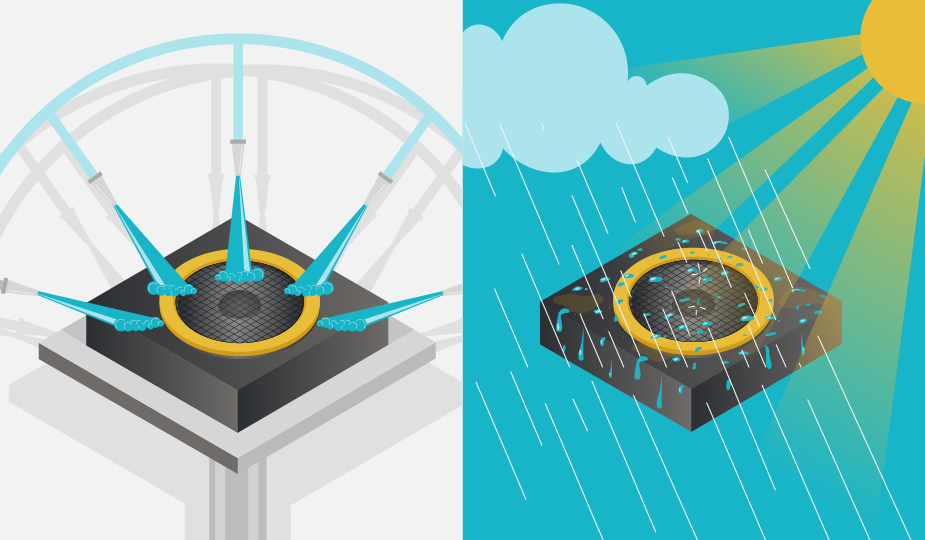
Standard IP tests are controlled snapshots. They are generally static, relatively short in duration, and performed on new assemblies. However, real products do not live in that world. They experience vibration, pressure cycling, thermal expansion and contraction, UV exposure, and long-term material aging. Seals that perform well in an initial qualification test may degrade after months or years of service, especially when the enclosure materials and sealing materials expand at different rates. That distinction matters because waterproof speaker mounting is rarely defeated by one dramatic event. More often, failure comes from small gaps opening over time, adhesive creep or failure, inconsistent compression at seals, or water finding a capillary path through a geometry that looked acceptable in CAD. Good design accounts for lifetime stress, not just first-pass validation.
How Does Sealing Affect Speaker Acoustics?
There is always a tradeoff between acoustic venting and sealing. Better sealing generally improves ingress resistance, but it can also affect sound pressure level and, particularly, low-frequency response. That means the sealing strategy should not be chosen in isolation. A speaker mounting approach that performs well mechanically may create unacceptable acoustic losses if it blocks or dampens the speaker’s intended output path. For product designers, the practical lesson is simple. Do not treat sealing as an afterthought delegated solely to mechanical packaging. The acoustic and mechanical teams need to work from the same constraints. A mount that is excellent for ingress protection but poor for output is likely the wrong design.
Which Sealant and Mounting Options Make the Most Sense?
Like most things in the engineering world, there is no universal “best” sealant. The right choice depends on compression consistency, serviceability, production scale, material compatibility, and how much process control the assembly line can maintain. There are four common options:
- Double-sided adhesive foam
- Silicone or RTV sealant
- Rigid bonding with cyanoacrylate (commonly known as Super Glue)
- Gaskets
No matter the solution, a clean, flat mating surface is always recommended. This may seem straightforward, but it is of the utmost importance because even a strong sealant strategy can be undermined by poor surface preparation or uneven mating geometry. We have another blog that covers the most important general mounting guidelines and best practices and discusses other considerations when mounting speakers.
Double-sided adhesive foam (DSAF) is often attractive because it can combine retention and sealing into a single step, which helps with assembly efficiency. However, we do not recommend this as the sole retaining solution. It depends heavily on consistent compression and surface quality and should be paired with another retaining method. Silicone or RTV is more forgiving in some geometries and can work well as a supplemental seal, but it adds cure time, process variability, and rework complexity. Rigid bonding can lock a part in place, but retention is not necessarily sealing, and brittle bonding strategies may not age well under vibration or thermal cycling. Gaskets are often one of the cleaner engineering solutions because they can separate sealing from bonding and improve serviceability. However, they require careful stack-up control and are usually a more deliberate hardware or enclosure feature.
In many robust designs, the best answer is not one method but a combination of methods. A stand-off plus adhesive foam, cyanoacrylate plus silicone, or a snap-fit plus silicone all reflect the same underlying principle: one feature retains, another seals. These functions should not be conflated. Redundant features usually improve long-term IP performance because the mechanical retention system and the elastomeric sealing system each do the job they are best suited for.

How Should Grille Design Help Manage Water?
A speaker grille should not just protect the speaker from impact or debris. It should also help shed water. A good grille design reduces water traps, limits capillary paths, and allows drainage rather than letting moisture collect behind the grille. Orientation matters here. Vertical mounting often helps water escape more naturally, while horizontal mounting can encourage pooling. Hole size and pattern also involve tradeoffs. Larger or more open patterns may improve drainage and acoustic transparency, but they can also expose the system more directly to environmental entry. This is one area where engineers benefit from application-level thinking. A speaker that survives immersion testing may still perform poorly in the field if the surrounding grille geometry repeatedly holds water where it should not.
What Environmental Stresses Should Engineers Plan for?
Environmental and lifetime considerations should be part of the design review early, not added after qualification failures. As mentioned, temperature cycling can stress seals through a coefficient of thermal expansion mismatch. UV can make materials brittle and degrade them over time. Vibration and shock can loosen retention features or fatigue bonds. And not all water exposure is equal – a little splashing will have significantly different loading conditions on your seals and different failure modes than high-pressure washdowns or immersion. The most important point is not to overcomplicate the analysis. It is to make sure that the seal strategy matches the service environment your product will actually see.
How Should Ingress Protection be Validated?
Ingress protection should be validated on the assembled product, not just inferred from the speaker datasheet. Visual inspection has value but is not enough by itself. Pressure testing, immersion testing, or other leak-check methods can reveal weaknesses much earlier in the development. Early leak testing is especially valuable because it helps teams catch sealing problems before tooling, supplier commitments, or design freezes make changes expensive. In other words, do not wait until the final validation to learn whether the mounting concept was flawed. Test the assembly early, revise quickly, and treat the speaker-enclosure interface as a critical system boundary.
Summary
In the end, successful waterproof speaker integration comes from treating ingress protection as a system-level engineering task. The speaker matters, but so do the mating surfaces, the seal material, the grille geometry, the environmental stresses, and the validation plan. Engineers who design with that broader view usually avoid the two most common mistakes: assuming the component rating is enough, and assuming the first successful lab test tells the whole story. Same Sky’s diverse of offering of waterproof speakers as well as our audio design services and speaker enclosure design services are also here to help engineers fine-tune their IP-rated design challenges.
Key Takeaways
- Waterproof speaker mounting is an application design problem, not just a component selection problem.
- An IP-rated speaker does not make the full product IP rated. Mounting, seal integrity, drainage, and surrounding enclosure features still determine system performance.
- Reliable designs usually separate retention and sealing. Redundant features tend to hold up better over time.
- Over-specifying IP ratings can add cost and complexity without improving real-world performance if the use case does not require it.
- Validation should focus on the assembled product and should happen early enough to avoid costly redesign cycles.
FAQs
Does an IP67 speaker make my enclosure IP67?
No, the speaker’s rating applies to the component under its test conditions. The finished enclosure still depends on mounting, sealing, drainage, and the IP performance of the rest of the design.
Is a higher IP rating always better?
No. Higher ingress protection can be necessary in some products, but it is not automatically the best choice. It can increase costs and design complexity without adding practical value if the actual exposure conditions are less severe.
What matters most when choosing a speaker sealant?
Compression consistency, re-workability, and manufacturing scalability are three of the most important factors. Surface preparation also matters more than teams sometimes expect.
Can retention features also provide sealing?
Technically yes, but they should not be assumed to do both equally well. In many durable designs, retention and sealing are handled by separate but complementary features.
 Tags:
Tags:
Additional Resources